
8 September 2022. The Palace of Knossos.


We stopped back at the Airbnb before heading down to the old Venetian Port to catch a cab back to Nikos Kazantzakis International Airport. There, we picked up the Enterprise rental car that I had reserved for the remainder of our Cretan adventure. It was a BMW SUV that had sufficient interior space for 4 gay Americans and their luggage (a real coup, by the way, as most rental cars on Crete are small by US standards). It wasn’t too pricey, and it served us well on the island.

The drive from the airport to Knossos took about 20 minutes. Parking was easy because we arrived in late afternoon (as the deepening shadows in the photographs make clear). The crowds had already thinned out from the morning rush, and we parked in the main lot with nary a tour bus in sight. Mind you, it was still hot, but several degrees cooler than it had been earlier.
Knossos is an old place, friends. The palace dates back to 1900 BCE, but the site itself was continuously occupied from the Neolithic (ca. 6,000 BCE) through the Mycenean invasion of Crete (ca. 1450 BCE) until its final destruction at the end of the Bronze Age (ca. 1200 BCE). You can see the fingerprints of time in the crushed, worn, and tilted ancient stones.


Michael P. and Aaron provide a reference for the scale of the area. Aaron is standing in what has been called the Reception Courtyard.
The photos above are actually on the far side of the site from where tourists enter Knossos today. I wanted to show them first as this impressive road is the main route by which ancient merchants, petitioners, worshippers, taxpayers, and emissaries would likely have approached the palace complex. At the moment, I’m confining my remarks to the history and architectural remains of Knossos. I’ll finish with a short discussion of the mythological aspects of the site.


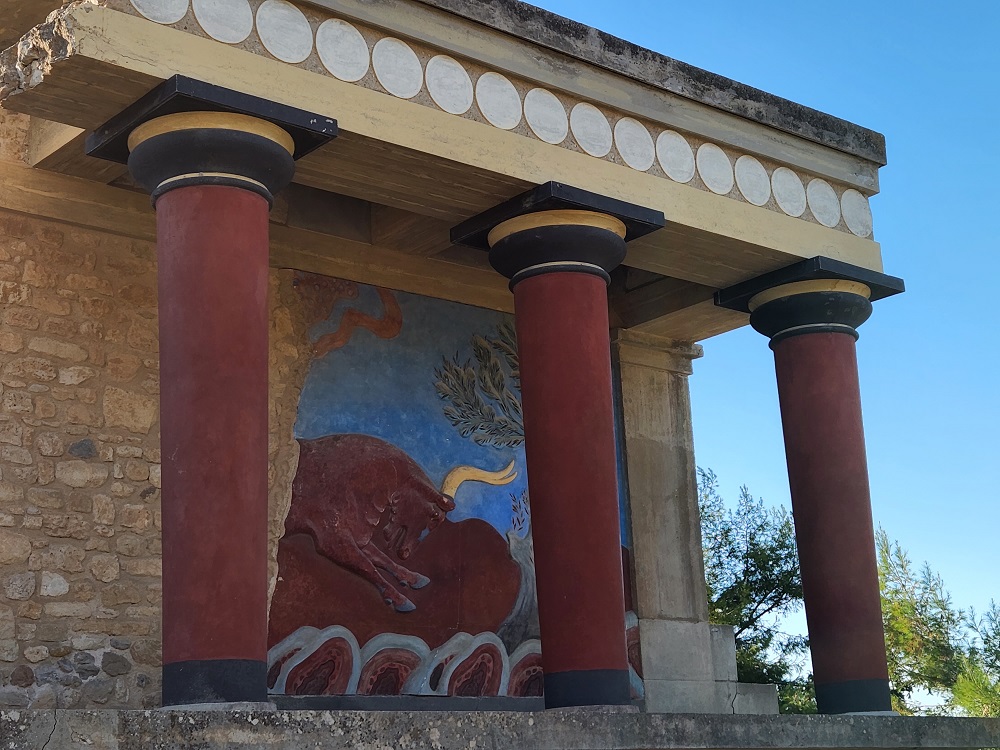
Above are several views of the reconstructed North Entrance with its magnificent bas relief of a charging bull that was said to have terrified the workmen when it was first uncovered.


Storage pithoi (above left and center). Many of these contained olive oil. When Knossos was sacked and destroyed at the end of the Bronze Age, the oil was set ablaze in order to aid in the destruction. The remnants of the fire can still be seen on some of the stonework (above right).


It’s a pity that we got there so late in the afternoon, as we had to hurry through the site. As a result, I didn’t manage to get photos of several key areas such as the Queen’s Megaron & the Central Court. I also wanted some photos of the ancient drainage system (I’m an engineer, after all). Not to worry, though, as I intend to return for a more through exploration. I did manage to snap a photo of the world-renowned Horns of Consecration which, with the labrys, has played such an outsized role in Greek-centered contemporary Paganism in the U.S.
The legend of Theseus and the Minotaur is the main reason that Knossos has captured the imaginations of people down through the ages. Did a half-man, half-bull man-eating monster live in a labyrinth constructed by Daedalus on the grounds of the Knossos palace? Who the hell knows? It certainly makes for a good story. The palace layout itself is a labyrinthine warren of rooms, halls, and courtyards, so there may be some truth hidden amidst all of that Bronze Age drama. What we do know is that Knossos was real.

The Minoan civilization has inspired artists and dreamers since Arthur Evans first began to publish his finds at Knossos. In particular, his work had influenced the gay pride movement and the development of contemporary Paganism. For further reading on this topic, I recommend Cathy Gere’s Knossos & the Prophets of Modernism (University of Chicago Press, 2009). It’s the first academic publication to cover this topic in depth. I reference it in Bull of Heaven: The Mythic Life of Eddie Buczynski and the Rise of the New York Pagan (Asphodel Press, 2012).

We left the site as the shadows continued to lengthen, stopping first at the gift shop to see what was on offer. Paul bought us all fresh pomegranate smoothies, which were a delight given that – late afternoon or not – we still had baked on that open stone site/bread oven. We stopped off at the tourist shops across the street from the entrance and picked up a few gifts for friends and family, and then we headed back into town. Aaron and I dropped off Paul and Michael P. at the Airbnb, and then found an overnight 24-hr garage for the SUV. We then walked back to our rooms and got ready for dinner. I honestly don’t remember much at all about the rest of the night because I was pretty exhausted. The next day we were heading to Chania prefecture.

— Να εχεις μια ωραια μερα. —
Leave a Reply