
8 September 2022. Aigai/Vergina and the Macedonian Royal Tombs

From the Archaeological Park of Dion, we headed south on Epar. Odos. Katerinis – Limena Litochoriou back to the E75 highway. From there, we headed north on the E75, sweeping up the west coast of the Themaic Gulf. The largest city that we passed was Katerini, a popular summer tourist destination which, in 8 days, would be celebrating its liberation from the Ottoman Empire in 1912. Greeks, who had occupied Anatolia since the Bronze Age, were ejected from Asia Minor in the wake of the Greek Genocide and the forced resettlement of Greeks and Turks in 1923. Many of these survivors and refugees settled in the area of Katerini.
At the village of Nea Agathoupoli we departed the E75 and took PEO Athinon Thessalonikis north to the village of Aiginio. From there we headed west on Epar. Odos Servion – Eginiou to the village of Meliki, followed by taking the Epar. Odos Verias – Kipselis to the ancient Macedonian city of Aigai (modern Vergina).


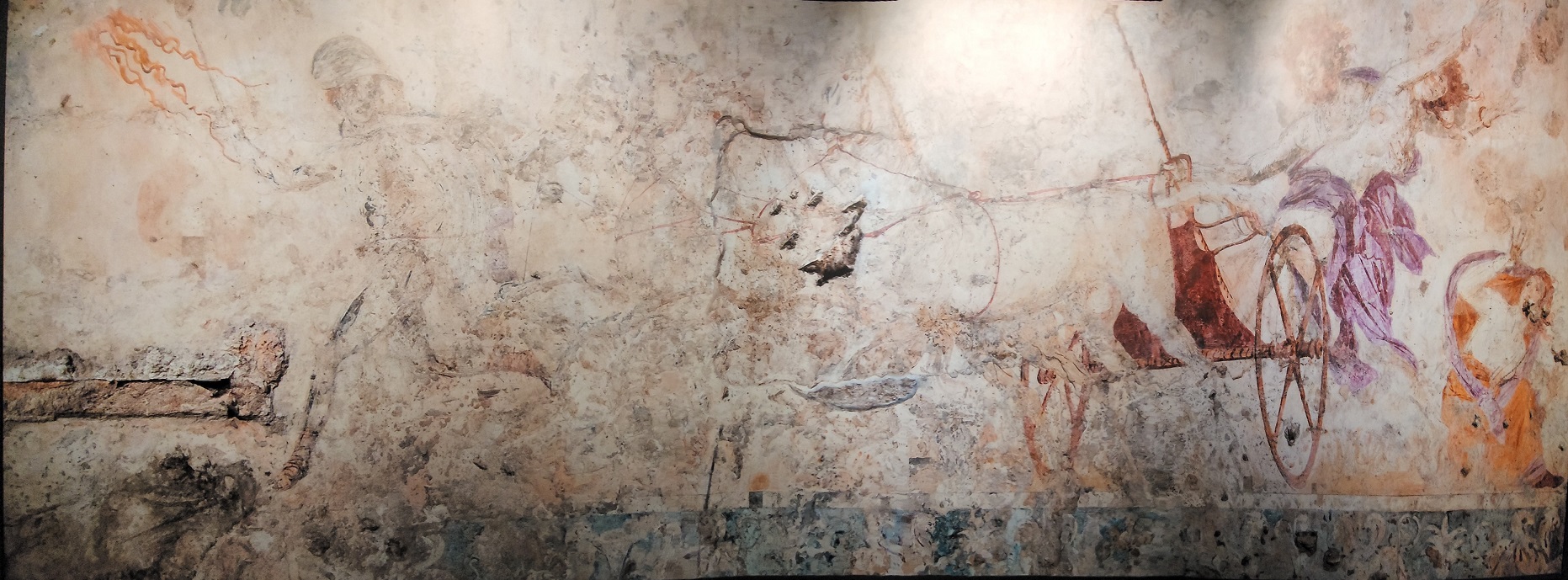
The Museum of the Royal Tombs is located beneath an engineered tumulus that encompasses several of the royal tombs. Tomb II is dated to 336 BCE and belonged to King Philip II of Macedon, father of Alexander the Great, and his wife, Meda. Tomb III has been linked to Alexander’s son, Alexander IV.
Aigai has a number of archaeological sites besides the Museum of the Royal Tombs, including the Polycentric Museum of Aigai, the remains of Philip II’s amphitheatre (where he may have been assassinated), numerous other tombs and tomb complexes, and the Palace of Aigai, which was built by Philip II and just re-opened to the public after restoration work. One enters the Museum of the Royal Tombs through a slanting entryway much like that of a Mycenaean tholos tomb. The first thing that one encounters after the ticket counter is a recreation of the original tholos area followed by a large collection of grave stele (below).


Contained within the museum are the actual tomb structures (I-IV) that were excavated, as well as a sacrificial structure called the Heroön that may have been dedicated to heroic cult worship.


The main attractions of the museum, and what occupy the bulk of the display cases, are the grave goods of Philip II. Above (left and right) is the larnax containing the cremains of King Philip II and the wreath that covered them in Tomb II. The larnax and wreath (left) belong to Princess Meda, one of the wives of King Philip II. She was buried in the anteroom of Tomb II.


Above, the silver banquet set of King Philip II which may have been used for his funeral banquet. Below, grave goods from Tomb II.

.


The chryselephantine decorative inlays from the remains of banqueting couches (above).


Left, a krater showing Dionysos with a maenad and satyr. Directly above, a mounted Amazon attacking a griffin.


Above, an ivory scene of a Bacchic parade in chryselephantine from a couch of Alexander IV. From Left-Right, a tripod, a satyr flute player, Dionysos, a maenad, and more satyrs/maenads. Below left, a closeup of the satyr, Dionysos, and maenad. Below right, terra cotta figurines, the top left of which may be Persephone.


One item that I had hoped to see while we were there was the magnificent throne of Queen Eurydice, Philip II’s mother. Unfortunately, it was on display elsewhere. It’s actually a miracle that any of these treasures have survived the centuries. The area had been heavily looted by Celtic mercenaries serving in the army of Pyrrhus during the Macedonian War of Succession in 276 BCE.
“Digging up the tombs of the [Macedonian] kings who had been buried there; the treasure they plundered, the bones they insolently cast to the four winds”.
Plutarch, Pyrrhus 26:6

The day was now rapidly passing and we needed to get to Thessaloniki Airport Makedonia in time to make our 10 pm flight to Crete. So we loaded up and headed north out of Vergina to E90, then headed east to link back up with the E75. The E75 became Route 1 outside of Thessaloniki. We ended up on Route 24 which took us to the rental car drop-off near the airport, stopping first for gas to top off the tank. We were cutting it a bit close for our flight, but Paul’s doctorate (albeit in anthropology) helped because an airport official escorted the good Dr’s party to the front of the security line. I had one minor annoyance in security, as I had neglected to thoroughly check my carry-on back-pack for inappropriate items and missed a jar of honey that I had bought for my mother in Delphi. Oh well, in the trash it went. The security agent was apologetic, but I waved away his apology saying that it was totally my fault. Sigh. I ended up buying her some Cretan honey instead.

We were mighty glad to make our flight and to finally land in Iraklio. I’ve wanted to see Minoan artefacts and sites for decades.

Our flight to Crete was packed, and we were almost the only people wearing COVID masks (which was odd given that it was still mandatory on all Greek mass transit at the time). The flight was uneventful, and we arrived in Iraklio a little before midnight. Arranging a cab to take all of us (and our luggage) to our Airbnb was a bit tricky, but we finally made it and were safely ensconced by around 1 am. We intended to sleep in a bit before another full day.
— Να εχεις μια ωραια μερα. —
Leave a Reply